
Non-Surgical Valve Replacement (TAVI) & Primary Angioplasty: Transforming Modern Cardiac Care
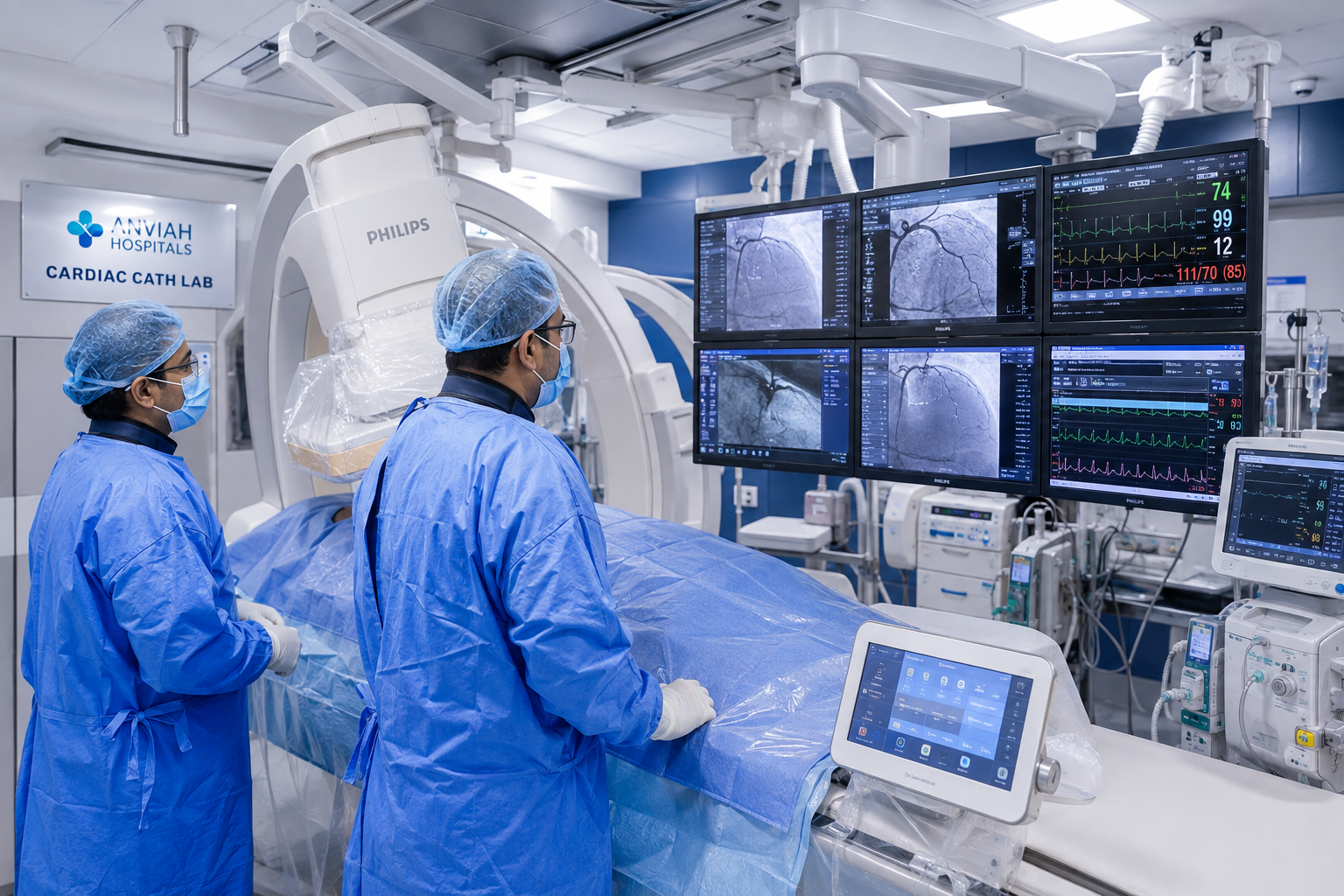
"Discover how catheter-based TAVI valve replacement and 24/7 STEMI primary angioplasty under 60 minutes are saving cardiac patients without open-heart surgery."
Key Highlights at a Glance
- Door-to-balloon time under 60 minutes maximizes myocardial muscle salvage in acute heart attacks.
- TAVI (Transcatheter Aortic Valve Implantation) allows aortic valve replacement via a tiny femoral puncture without opening the chest.
- Intravascular Ultrasound (IVUS) and Optical Coherence Tomography (OCT) ensure sub-millimeter precision stent placement.
- Most patients undergoing catheter-based cardiac interventions are mobilized within 24 hours and discharged in 48 hours.
1. Overview & Understanding the Condition
Cardiovascular disease remains the leading cause of clinical emergencies worldwide. When a coronary artery becomes acutely obstructed by an atherothrombotic plaque, myocardial cells begin to suffer irreversible ischemic necrosis within minutes. Modern interventional cardiology has completely transitioned from high-risk open-chest surgeries to high-precision, catheter-based endovascular interventions.
2. Common Symptoms & How It Is Diagnosed
Critical Heart Attack Warning Signs Requiring Immediate Emergency Care:
3. Treatment & Care Options
Our 24/7 STEMI (ST-Elevation Myocardial Infarction) emergency protocol at Anviah Hospitals guarantees an audited door-to-balloon time under 60 minutes. From the emergency triage bay, patients are directly transferred to our bi-plane Cath Lab equipped with fractional flow reserve (FFR) and IVUS imaging. This enables our team to clear the thrombus, deploy drug-eluting stents (DES), and restore physiological coronary perfusion before permanent myocardial necrosis occurs.
4. Recovery & Daily Care Guidelines
Advanced Non-Surgical TAVI / TAVR Protocols:
Eliminates aortic valve calcification bottlenecks via a collapsible artificial valve
Delivered through a tiny 5 mm groin sheath under conscious sedation
Safely performed in elderly patients aged 65+ unsuitable for conventional sternotomy
Instantaneous gradient reduction and normal cardiac output restoration
Post-procedure rehabilitation focuses on structured cardiac recovery, antiplatelet therapy adherence, lipid management, and supervised physical conditioning. Under the leadership of Dr. Sri Ramulu Kadiyala, our interventional cardiology faculty provides comprehensive pre-op risk stratification, intraoperative hemodynamic monitoring, and individualized long-term cardiovascular prevention plans.
Frequently Asked Questions (FAQs)
Clinical guidance & patient care protocols for Cardiology & Interventional Heart Care
TAVI is recommended for patients diagnosed with severe symptomatic aortic valve stenosis, particularly elderly individuals (aged 65+) or patients with comorbidities (diabetes, renal compromise, prior bypass surgery) where open-heart surgery carries elevated surgical risk.

Dr. Sri Ramulu Kadiyala
Verified ConsultantConsultant Interventional Cardiologist
Department of Cardiology & Interventional Heart Care • Anviah Hospitals Gachibowli
This article is written and reviewed by our senior hospital doctors to ensure clear, accurate, and trustworthy health guidance for you and your family.
* Note: This guide is for general health awareness and does not replace personal consultation with a doctor.